I often curse the day my husband got his PA. He claimed he was going to make money running sound for other bands and it would pay for itself. It would also provide him with band security, because he'd be the one with the PA, harder to kick out of the band.
So, for years, an entire room in the apartment became the storage room for the PA, then a room in the house. One of the cars always has to be big enough to haul the PA. And it never really pays for itself because things break, things have to be replaced, bands that make money buy their own PA, and bands that don't make money don't want to pay anything reasonable for PA. So you end up just being the guy in your own band that always brings the PA.
And if you're the girl dating the guy in the band that brings the PA, and you ride with him, then you're there two hours before the gig starts and at least an hour after it's over. It's a long night. In the last few years, there's been few paying jobs and more no pay jobs running sound for friends' parties.
Musician parties are tantamount to Woodstockian events. Musicians know other musicians, so there's usually eight to 20 bands. These things start early in the afternoon and go into the wee hours because people just don't go home. They camp out. They drum circle. They sleep on the lawn. If you're bringing the PA, you go in at 11 a.m. to set up, and when the final band gives up at 1 or 2 in the morning, then there's another hour or two of amateurs, people who can't play, people who can't sing, people who are drunk, who want to take advantage of the live mic and live out a fantasy for awhile. If you're a nice guy like my husband, you don't pull the plug on them until everyone at the party is comatose.
In the beginning, when I was working on our relationship, or felt it needed to be supported, I would go to these ordeals, but I am notoriously and famously the Least Fun Person at Any Party. Now I don't go. I'm just not there. I fantasize about going to parties in a normal way, when things are well underway and then leaving before they get stupid. I fantasize about having a date for parties who actually hangs out with me, who isn't either chained to the PA for 15 hours or on stage himself. (Probably the key was to date someone who likes music, not someone who plays music.)
So my husband comes back from these things and says, "Everyone asked about you." He thinks they missed me. But I know, being the Least Fun Person at Any Party, that's not the case. I tell him, "They ask about me because they think we've broken up. They're just checking to see if there is any way possible we could still be together when you're always at these things alone." (Well, I suppose he's alone. I wouldn't know. I'm not there.)
Sunday, June 24, 2007


Sunday, June 03, 2007
My Long History with the Journal
The Richmond Music Journal was hatched in the summer of 1993. From 1989 until then, I had worked on Night Moves, Richmond Along the James, Livewire, Focus, Oh!, and various other free distribution entertainment tabloids that collapsed within a year or two due to various mismanagements. Inevitably, more money was spent than made; no one ever wanted to do the dirty work of selling ads; the writers were never paid; the writers were never edited; no one knew anything about basic journalism; and too many copies were printed. At one paper, no one wanted to drive around town distributing the paper. The copies sat in the office!
So when the dust settled once again in ’93, I decided I would do a paper myself. To make it easier to sell ads, I would focus on a single topic. I had been a book, movie and restaurant reviewer at various times of my career, so the unlikeliest direction was music. Besides, I had a crush on a musician who had stopped seeing me, the now deceased Frank Daniel, and I thought this paper would peak his interest again.
It didn’t, but I met another musician and lived happily ever after anyway. (Or as happy as anyone gets.)
In case anyone ever wants to start a paper, here's the secret. The paper was planned for three months before the premiere issue came out in November 1993. I sent out an information packet to every likely advertiser and was amazed to get 12 ads for the first issue from that mailing. I put up $250 as a starter fund. I originally had a partner who was also going to put up $250, but he didn’t, and that was the end of him. I never had to use my own money again, and over the years the paper paid for my computer software and occasionally even paid the rent or a utility bill.
My short-lived partner wanted to call the paper Core. I opted for the Richmond Music Journal because it made short work of explaining what the paper was about. It would be a journal, a diary, of Richmond music. We would not do “pre-shows,” which are interviews with bands before they come to town. That, I’ve always felt and still believe, is the purpose of advertising. We would only review. That hurt us, advertising-wise, although it’s also been my experience that 1) if a band can get a pre-show article, they’re even less likely to buy an ad; and 2) bands won’t buy ads anyway. They’re always too broke, too business-stupid, or too arrogant.
I had two great influences when creating the Journal. The first was ex-Rolling Stone Bill Wyman’s book Stone Alone, in which he wrote about the little music newspapers in England and their popularity polls. He kept an eye on how he was doing in the Best Bass Player rankings. I would always have some kind of popularity poll, and I would focus on local music.
The second influence was the New Yorker magazine. The Journal layout and design was very similar, columns of straight text with only the occasional photo or cartoon, simple, readable and clean. The emphasis would be, like the New Yorker, on analytical commentary and review.
The quality of writing has not been consistent over the years since I’ve gone through dozens of writers—some better than others—but I seldom flat-out rejected anyone’s submission. With some editing, anything can be shaped into a readable piece that at least vaguely resembles analytical commentary. The articles I never got around to using were inevitably about a regional or national musician or band. I put the local material first, a practice I think would save the Richmond Times-Dispatch, but they refuse to believe it.
Having been a freelance writer for 20 years before starting the Journal, I know how frustrating it is, and I decided to try to publish everyone who submitted work. And I would pay them, even if it was just $5. And I did. Some writers have waived payment, which helped our bottom line, and I thank them for that. Some wrote for advertising credit. One band paid me in Mac software and that was a tremendous deal. Doing this paper taught me how to use QuarkXPress and Photoshop, and those skills enabled me to get progressively better paying day jobs.
Not only did I improve my marketable skills, I met my husband in 1996 through the paper. I missed meeting him in 1993 because I never got around to seeing the band Stiff Richard when it played the Metro. Copies of their CD came in and the paper reviewed them unfavorably. Around then I met Peter Bell, formerly of Ten Ten, who was eager to write and be written about. And when he formed the band October, he brought to my attention that one of his guitarists looked very much like Frank Daniel, the musician who had inspired me to launch the Journal. I went to a show at Jimmy Ryan’s and saw that he did, but he was also much too young for me. Journal reviewers consistently panned October so I kept a discreet distance, although I went to every show I could just to look.
Fast forward a year. I had met Keith MacPhee when he was in Joe America, and when he moved on to Grumbledog with Keith Clarke, they invited me to a show. The band was just a three-piece when I saw it at Twisters, but in the summer of 1996 when I saw them again at the Sunset Grill, they had added a guitar player, the same guy who used to be in October. With shorter hair and a goatee, he looked older. I dated him through Grumbledog, the great Thelma Shook, Bobby and Greg, the Colossal Eds and Mozo.
For a long period, he ran sound more than he played, especially a long standing regular gig with Whistler's Mother, but I'm sure that was frustrating for him not to be playing, and on a few colorful occasions, he was royally stiffed by young, arrogant, asshole little kid bands that didn't want to pay him after contracting his services. I had to declare war against them in the Journal because I'm Italian and that's what we do. Sometimes it shook the money loose and sometimes it didn't.
My relationship with this musician became a problem as far as the paper was concerned. My friends became his friends and band mates. He brought new people into my circle, and all of them were musicians. I was now fatally compromised. It would be very difficult to maintain a peaceful relationship with him and his friends and bandmates and still write honest reviews of their bands. Even good reviews would be suspect. I continued to serve as publisher, editor and sole ad salesman for the Journal, but I stepped down for the most part as a writer. It got to the point we only went out to see his friends play, and then to the point where we only went out when he was playing. The paper got smaller.
We were married in 2001, despite the age difference, and he went on to play with CBJ with Cy Taggart and John Leedes, the Harrison Deane Band, Us, B2B, and various smaller units that came and went quickly.
In the end, the Journal was good to me personally. It never became huge, but it also never collapsed into debt-ridden ruin like Pulp Radio, Punchline, and other similar papers that have come and gone. At its height, which was around 1995, the Journal was sometimes 48 pages. That's a big paper for one done on a kitchen table by a single person. Summers were especially fruitful with full-page ads for big touring shows at the Landmark and Classic Amphitheatre.
I would normally go out four or five nights a week, hitting three to five clubs each night, seeing and photographing as many as 12 bands a night, and doing more than half the writing myself. Staying out until the bars closed was routine. One night I even got beat up and robbed in front of Main Street Station, my reward for being the last person in the Bottom on a Friday night after a Suzy Saxon and the Anglos show at Alley Katz.
It was easier when the clubs were clustered. There was a time when the Grace and Laurel corridor near VCU would have at least three live music clubs within walking distance. Then the Bottom opened up, and you could literally walk around one block and catch sets in five or more different clubs. West Main through the Fan was a corridor of clubs for a short time, although you couldn’t visit them all easily without moving your car. They are all just restaurants now.
Live music spread into the suburbs. Parking is convenient and free, but you have to commit to one club per evening. You can’t go elsewhere during the break and then come back without a lot of driving.
The other problem is burnout. Every band interview sounds so similar to every other band interview, you feel like a hamster in a wheel when you've been writing for even just a few years. There’s seldom anything new to write about the continuing struggle of bands to get a record contract. When they succeed, it’s essentially the same story, and when they fail, it’s even more the same story. That’s why the paper always needed new writers who hear this story with new ears and write it up like it’s never been written before.
As the years passed, and I actually started getting day jobs, it was hard to go out even one night a week. The Journal continued, though, due to the faithfulness of a couple of writers, Walter Boelt and Robert Stutler, and advertisers who still supported it like the Boulevard Deli, A Major Music and Oasis Duplicating. Then the Boulevard Deli closed. The math was no longer there to pay the printer.
I still enjoyed doing the calendar, the polls, and compiling the always interesting and funny letters and comments, so I gradually began moving the paper's content to the Internet, bit by bit. I was printing 1,000 copies of the paper, but getting up to 2,000 hits a month on the website. It seemed more people were reading it online. That was verified each month when I brought the paper around to the record and equipment stores and found too many old copies were still around. It was time to stop the print edition in the spring of 2005 after a few final bimonthly issues.
I wasn’t sure until it was over when the last issue would be, so it was never announced in print. There was very little outcry, and not even a mention in the other papers that we had ceased, when the deaths of less successful papers had been reported. That has always bugged me. Eleven years of nonstop publishing should have been noted by someone.
Maybe that’s because we’re not really gone yet, but we’re certainly a shadow of our former selves. The print edition ended without debt. In fact, there was a little money left over. To me, and probably only me, it was a great success.
For the past year or so, I've been watching another paper, Brick, make all the classic mistakes, and struggle for an audience, even with the backing of Media General. It shouldn't be this hard to do a good local paper. It is hard, but that's the trick, not taking the easy way out by using too much syndicated material. Local stories and many local photos are key. If you make your readership your story, you have faithful readers because we like to read about ourselves and people we know. (This would become by 2012 the multi-zillion dollar basis of Facebook.) Putting a town on the map for arts and music requires a very intensive coverage of the local arts and music. Otherwise, what's the point of a local paper?
So when the dust settled once again in ’93, I decided I would do a paper myself. To make it easier to sell ads, I would focus on a single topic. I had been a book, movie and restaurant reviewer at various times of my career, so the unlikeliest direction was music. Besides, I had a crush on a musician who had stopped seeing me, the now deceased Frank Daniel, and I thought this paper would peak his interest again.
It didn’t, but I met another musician and lived happily ever after anyway. (Or as happy as anyone gets.)
In case anyone ever wants to start a paper, here's the secret. The paper was planned for three months before the premiere issue came out in November 1993. I sent out an information packet to every likely advertiser and was amazed to get 12 ads for the first issue from that mailing. I put up $250 as a starter fund. I originally had a partner who was also going to put up $250, but he didn’t, and that was the end of him. I never had to use my own money again, and over the years the paper paid for my computer software and occasionally even paid the rent or a utility bill.
My short-lived partner wanted to call the paper Core. I opted for the Richmond Music Journal because it made short work of explaining what the paper was about. It would be a journal, a diary, of Richmond music. We would not do “pre-shows,” which are interviews with bands before they come to town. That, I’ve always felt and still believe, is the purpose of advertising. We would only review. That hurt us, advertising-wise, although it’s also been my experience that 1) if a band can get a pre-show article, they’re even less likely to buy an ad; and 2) bands won’t buy ads anyway. They’re always too broke, too business-stupid, or too arrogant.
I had two great influences when creating the Journal. The first was ex-Rolling Stone Bill Wyman’s book Stone Alone, in which he wrote about the little music newspapers in England and their popularity polls. He kept an eye on how he was doing in the Best Bass Player rankings. I would always have some kind of popularity poll, and I would focus on local music.
The second influence was the New Yorker magazine. The Journal layout and design was very similar, columns of straight text with only the occasional photo or cartoon, simple, readable and clean. The emphasis would be, like the New Yorker, on analytical commentary and review.
The quality of writing has not been consistent over the years since I’ve gone through dozens of writers—some better than others—but I seldom flat-out rejected anyone’s submission. With some editing, anything can be shaped into a readable piece that at least vaguely resembles analytical commentary. The articles I never got around to using were inevitably about a regional or national musician or band. I put the local material first, a practice I think would save the Richmond Times-Dispatch, but they refuse to believe it.
Having been a freelance writer for 20 years before starting the Journal, I know how frustrating it is, and I decided to try to publish everyone who submitted work. And I would pay them, even if it was just $5. And I did. Some writers have waived payment, which helped our bottom line, and I thank them for that. Some wrote for advertising credit. One band paid me in Mac software and that was a tremendous deal. Doing this paper taught me how to use QuarkXPress and Photoshop, and those skills enabled me to get progressively better paying day jobs.
Not only did I improve my marketable skills, I met my husband in 1996 through the paper. I missed meeting him in 1993 because I never got around to seeing the band Stiff Richard when it played the Metro. Copies of their CD came in and the paper reviewed them unfavorably. Around then I met Peter Bell, formerly of Ten Ten, who was eager to write and be written about. And when he formed the band October, he brought to my attention that one of his guitarists looked very much like Frank Daniel, the musician who had inspired me to launch the Journal. I went to a show at Jimmy Ryan’s and saw that he did, but he was also much too young for me. Journal reviewers consistently panned October so I kept a discreet distance, although I went to every show I could just to look.
Fast forward a year. I had met Keith MacPhee when he was in Joe America, and when he moved on to Grumbledog with Keith Clarke, they invited me to a show. The band was just a three-piece when I saw it at Twisters, but in the summer of 1996 when I saw them again at the Sunset Grill, they had added a guitar player, the same guy who used to be in October. With shorter hair and a goatee, he looked older. I dated him through Grumbledog, the great Thelma Shook, Bobby and Greg, the Colossal Eds and Mozo.
For a long period, he ran sound more than he played, especially a long standing regular gig with Whistler's Mother, but I'm sure that was frustrating for him not to be playing, and on a few colorful occasions, he was royally stiffed by young, arrogant, asshole little kid bands that didn't want to pay him after contracting his services. I had to declare war against them in the Journal because I'm Italian and that's what we do. Sometimes it shook the money loose and sometimes it didn't.
My relationship with this musician became a problem as far as the paper was concerned. My friends became his friends and band mates. He brought new people into my circle, and all of them were musicians. I was now fatally compromised. It would be very difficult to maintain a peaceful relationship with him and his friends and bandmates and still write honest reviews of their bands. Even good reviews would be suspect. I continued to serve as publisher, editor and sole ad salesman for the Journal, but I stepped down for the most part as a writer. It got to the point we only went out to see his friends play, and then to the point where we only went out when he was playing. The paper got smaller.
We were married in 2001, despite the age difference, and he went on to play with CBJ with Cy Taggart and John Leedes, the Harrison Deane Band, Us, B2B, and various smaller units that came and went quickly.
In the end, the Journal was good to me personally. It never became huge, but it also never collapsed into debt-ridden ruin like Pulp Radio, Punchline, and other similar papers that have come and gone. At its height, which was around 1995, the Journal was sometimes 48 pages. That's a big paper for one done on a kitchen table by a single person. Summers were especially fruitful with full-page ads for big touring shows at the Landmark and Classic Amphitheatre.
I would normally go out four or five nights a week, hitting three to five clubs each night, seeing and photographing as many as 12 bands a night, and doing more than half the writing myself. Staying out until the bars closed was routine. One night I even got beat up and robbed in front of Main Street Station, my reward for being the last person in the Bottom on a Friday night after a Suzy Saxon and the Anglos show at Alley Katz.
It was easier when the clubs were clustered. There was a time when the Grace and Laurel corridor near VCU would have at least three live music clubs within walking distance. Then the Bottom opened up, and you could literally walk around one block and catch sets in five or more different clubs. West Main through the Fan was a corridor of clubs for a short time, although you couldn’t visit them all easily without moving your car. They are all just restaurants now.
Live music spread into the suburbs. Parking is convenient and free, but you have to commit to one club per evening. You can’t go elsewhere during the break and then come back without a lot of driving.
The other problem is burnout. Every band interview sounds so similar to every other band interview, you feel like a hamster in a wheel when you've been writing for even just a few years. There’s seldom anything new to write about the continuing struggle of bands to get a record contract. When they succeed, it’s essentially the same story, and when they fail, it’s even more the same story. That’s why the paper always needed new writers who hear this story with new ears and write it up like it’s never been written before.
As the years passed, and I actually started getting day jobs, it was hard to go out even one night a week. The Journal continued, though, due to the faithfulness of a couple of writers, Walter Boelt and Robert Stutler, and advertisers who still supported it like the Boulevard Deli, A Major Music and Oasis Duplicating. Then the Boulevard Deli closed. The math was no longer there to pay the printer.
I still enjoyed doing the calendar, the polls, and compiling the always interesting and funny letters and comments, so I gradually began moving the paper's content to the Internet, bit by bit. I was printing 1,000 copies of the paper, but getting up to 2,000 hits a month on the website. It seemed more people were reading it online. That was verified each month when I brought the paper around to the record and equipment stores and found too many old copies were still around. It was time to stop the print edition in the spring of 2005 after a few final bimonthly issues.
I wasn’t sure until it was over when the last issue would be, so it was never announced in print. There was very little outcry, and not even a mention in the other papers that we had ceased, when the deaths of less successful papers had been reported. That has always bugged me. Eleven years of nonstop publishing should have been noted by someone.
Maybe that’s because we’re not really gone yet, but we’re certainly a shadow of our former selves. The print edition ended without debt. In fact, there was a little money left over. To me, and probably only me, it was a great success.
For the past year or so, I've been watching another paper, Brick, make all the classic mistakes, and struggle for an audience, even with the backing of Media General. It shouldn't be this hard to do a good local paper. It is hard, but that's the trick, not taking the easy way out by using too much syndicated material. Local stories and many local photos are key. If you make your readership your story, you have faithful readers because we like to read about ourselves and people we know. (This would become by 2012 the multi-zillion dollar basis of Facebook.) Putting a town on the map for arts and music requires a very intensive coverage of the local arts and music. Otherwise, what's the point of a local paper?
Sunday, April 15, 2007
Thelma Shook at Moondance April 1998
This was recorded April 10, 1998 at the Beex show at Moondance. Thelma Shook was the middle band and decorated the stage as the deck of the Titanic with cannibalistic penquins all around the club. Most of the tape is obscured by people standing right in front of the camera, which no one was manning so it's a static shot. I managed to find three songs that allow a view of the band most of the time, "Losing My Direction," "Dog" and "Invisible Again" which should really be called "See Me Now." Dean Owen is a genius songwriter. The two known Thelma Shook CDs are even better.
Saturday, March 24, 2007
Harrison Deane Band at Irish Festival
"Money"
Irish Festival, Church Hill, March 24, 2007
Bobby Jorgenson is on vocals on this particular cover.
Saturday, December 09, 2006
Case Studies
The most enduring local bands do not necessarily have the greatest talent, but the greatest compatibility of temperament types. You can’t have a band with four charismatic leaders. There is a leader—often the person who felt the need for the band in the first place—and the others. No matter what they call themselves, they’re Giant Ego and the Yes Men, or Spotlight on Me and the Interchangeable Sidemen.
I suppose there are some musicians who put together bands because they enjoy playing music. Rather than ending with fireworks, they quietly peter out because the players can no longer find the time to practice or do the work involved in booking and performing. Or like Hootie and the Blowfish, they make their money, buy their houses, and retire early to play golf.
But more often there is always one person in the band who is the Problem, or as I like to call him, the Giant Asshole, the Ego from Hell, the Big Baby, the one who cannot comprehend that not everything is about him because, to him, it most surely is.
That’s why he’s in a band. For the attention-starved, it is necessary to stand in a spotlight and inflict your music on an indifferent audience and thus feel superior to those whose only talent is being the audience.
In one band I liked, three of the four enjoyed playing music, but all had day jobs. Music was a hobby. A record contract was a very distant dream, like winning the lottery.
The fourth was a full-blown Lost Boy in Neverland. He considered the band his full-time job, a luxury made possible by a girlfriend with a job. He did the booking, wrote many of the songs, fronted the band, got stinking drunk every show and fought with the bartenders. He complained endlessly that he had to do everything—the others never did anything—to advance the band. He was the hub and everything to do with the band revolved around him.
Then someone else in the band actually did something that advanced the band to the next level. You would think Mr. Hub would be happy. Instead, he fired the guy. When the dust settled, the psychology became clear. Hub’s need to be the catalyst of progress in the band was his only goal—more than having the band succeed. It was his excuse for never having to get a day job. Despite his complaints, if someone actually did anything to help the band, it diminished the band’s dependence on him. Thus, the band had to be destroyed.
Another band I enjoyed had two brilliant co-songwriters who could create genius together but not apart. The different bands they continually built around themselves were incidental.
The two couldn’t have been more different. One hated playing out and wanted to let demo records be the only road to the record deal. The other wanted the band to be lifted into stardom through playing out as much as possible and becoming a word of mouth sensation, much like the Dave Matthews Band did. To divert themselves from killing each other, they turned on their sidemen instead. They agreed — because they had to in order to stay together — that the problem was always the other guys. They invented faults and dramas to continually break the bands up without ever dealing with each other.
Then there was the Giant Asshole who played in a regional touring band, but he wasn’t the frontman who got the attention and a bigger cut of the money. So he started his own band, but he still needed a guy who could do all the things he could not—sing, talk to the audience, and yet not appear to be the frontman, even though he clearly would be.
Giant Asshole determined where everyone stood on stage, the song choices, what nights they practiced, which songs would go onto the costly CD where his guitar tracks would be layered in the dozens. He even determined who was allowed to collect the money at the end of the night.
The only thing he couldn’t control was the tendency of the audience and the media to focus on the guy who was singing. This is often a problem with guitar players and vocalists, whether it’s Jagger and Richards or Axl and Slash. Who represents the band? When the photograph in the paper shows only the vocalist, when the reporters tend to quote only the vocalist—the guitar-player wants to kill him. Like Eddie Van Halen, fire enough vocalists and you don’t have a band anymore.
I suppose there are some musicians who put together bands because they enjoy playing music. Rather than ending with fireworks, they quietly peter out because the players can no longer find the time to practice or do the work involved in booking and performing. Or like Hootie and the Blowfish, they make their money, buy their houses, and retire early to play golf.
But more often there is always one person in the band who is the Problem, or as I like to call him, the Giant Asshole, the Ego from Hell, the Big Baby, the one who cannot comprehend that not everything is about him because, to him, it most surely is.
That’s why he’s in a band. For the attention-starved, it is necessary to stand in a spotlight and inflict your music on an indifferent audience and thus feel superior to those whose only talent is being the audience.
In one band I liked, three of the four enjoyed playing music, but all had day jobs. Music was a hobby. A record contract was a very distant dream, like winning the lottery.
The fourth was a full-blown Lost Boy in Neverland. He considered the band his full-time job, a luxury made possible by a girlfriend with a job. He did the booking, wrote many of the songs, fronted the band, got stinking drunk every show and fought with the bartenders. He complained endlessly that he had to do everything—the others never did anything—to advance the band. He was the hub and everything to do with the band revolved around him.
Then someone else in the band actually did something that advanced the band to the next level. You would think Mr. Hub would be happy. Instead, he fired the guy. When the dust settled, the psychology became clear. Hub’s need to be the catalyst of progress in the band was his only goal—more than having the band succeed. It was his excuse for never having to get a day job. Despite his complaints, if someone actually did anything to help the band, it diminished the band’s dependence on him. Thus, the band had to be destroyed.
Another band I enjoyed had two brilliant co-songwriters who could create genius together but not apart. The different bands they continually built around themselves were incidental.
The two couldn’t have been more different. One hated playing out and wanted to let demo records be the only road to the record deal. The other wanted the band to be lifted into stardom through playing out as much as possible and becoming a word of mouth sensation, much like the Dave Matthews Band did. To divert themselves from killing each other, they turned on their sidemen instead. They agreed — because they had to in order to stay together — that the problem was always the other guys. They invented faults and dramas to continually break the bands up without ever dealing with each other.
Then there was the Giant Asshole who played in a regional touring band, but he wasn’t the frontman who got the attention and a bigger cut of the money. So he started his own band, but he still needed a guy who could do all the things he could not—sing, talk to the audience, and yet not appear to be the frontman, even though he clearly would be.
Giant Asshole determined where everyone stood on stage, the song choices, what nights they practiced, which songs would go onto the costly CD where his guitar tracks would be layered in the dozens. He even determined who was allowed to collect the money at the end of the night.
The only thing he couldn’t control was the tendency of the audience and the media to focus on the guy who was singing. This is often a problem with guitar players and vocalists, whether it’s Jagger and Richards or Axl and Slash. Who represents the band? When the photograph in the paper shows only the vocalist, when the reporters tend to quote only the vocalist—the guitar-player wants to kill him. Like Eddie Van Halen, fire enough vocalists and you don’t have a band anymore.
Friday, November 24, 2006
Still Supporting Yoko and Heather

I guess I am a sucker for anything Beatles because I've bought their music many times over now. First, I bought the original LPs as they came out over the years, as well as all the 45 rpms. And don't think it was easy saving up the $3.99 or whatever the albums cost back then. I even bought the 101 Strings versions of Beatle songs. When I lost all my books and records in a move in 1969, I had to buy all the LPs over again, adding McCartney's first solo album to the group. I never bought anything by Wings or any other Beatle after that, although I would keep acquiring the same body of work over and over.
I sold all my records to buy a crib when I was a young, broke, almost homeless mom, and a couple of decades later, Frank, the beloved, shocked to learn I no longer had a single Beatles album, gave me a set of cassettes with every single song on them. Then I got a CD player and gradually bought all the albums on CD, although they were the British releases. I bought the three anthology double disc CDs, and gradually sold them off on eBay because after one or two listens, I really don't need to own old, scratchy cover tunes from when they were starting out, or the rejected versions of songs, or BBC studio versions. Then I bought the Beatles No. 1 hits CD. At this point, I really should be done. And yes, I have the Anthology on DVD, which I've watched a time or two. And the big book. What I liked the most about the Anthology video was the Shea Stadium scenes.
Over the years, I've bought DVDs with the Ed Sullivan shows, and the George Harrison tribute, watched them, and sold them on eBay. This was before Netflix. I don't collect anything that's John and Yoko, because she ruined him. She put him on a fatal pedestal. I can't look at photos of him with her. I am still on Team Cynthia.
Then my third husband gave me the boxed set of the American albums on CD, which I didn't even want. I doubt I've listened to these even once, but I own them. Seeing the old album covers again, covers I had studied so intently as a teen, was an odd feeling. I own a couple of CDs of bluegrass versions of Beatles songs, too. I like those because I love banjo. Last Christmas I bought the remix of "Let It Be," the way it was supposed to be before it was Phil Spectored. I listened to that twice. I like it better than the original "Let It Be."
Today, I bought the Cirque du Soleil mix "Love," put together by George Martin and his son, a mix of various Beatle tracks, all cooked and stirred into a big stew. The reviews for this album are all raves. Remember the Scariens? "Love" is like that, you hear the music to one song, but the lyrics to another, different combinations of songs lead in and out.
And what is my favorite Beatles songs? They're songs that never make it onto all these re-releases. I like two of the lesser known songs from the "Help" soundtrack, "The Night Before" and "Another Girl." My favorite 45 rpm was "I Feel Fine" with "She's a Woman" on the B side. They make me happy. When I hear those, I literally get a taste in my mouth that reminds me of my youth. I can smell the memories of where I was and who I used to be, with everything still in front of me, with the possibility of a good life still...possible.
Saturday, November 04, 2006
Happy Again
It's the myspace.com phenom. Everyone has a page and so when the young die young, there's a mental photograph left behind. It collects clues to the mystery of life, and sometimes to the mystery of death, as in the case of Taylor Behl whose page linked her to her killer through their relationship as curious strangers intertwining in some bizarre, sick way.
I didn't go to Chris Williams' funeral because my husband arranged to go with friends so I wouldn't have to take off from work. I surfed over to his myspace page instead and picked up the last two entries. A week before he died, he posted to his fans that he had opted to "rejoin the fellows for our first official tour to promote the release of our upcoming DVD."
The post before that goes back four months to June. "I have been on a journey like no other the past couple of months. I have truly had to search deep within to find out who I am and what kind of person I want to be. Well, I figured it out. I want to be a man, a great husband eventually, a great father eventually, an amazing drummer, and most of all, a person that people enjoy being around. Hopefully my dad would be proud of the man that I am and the man I want to be! Happy again."
Happy again? So perhaps there was a crisis of identity, an unjoining with the band, that had been resolved briefly before the end. It reminded me of Frank, coming out of his second failed marriage, putting together what he perceived as his perfect band, finally getting the players he wanted, and then dying alone in the house. That's why I don't trust happiness. The journey like no other is always one of discomfort, pain, indecision, striving, trying, working hard, goals just out of reach. When you hit happy, it's like end game. I don't trust it.
I didn't go to Chris Williams' funeral because my husband arranged to go with friends so I wouldn't have to take off from work. I surfed over to his myspace page instead and picked up the last two entries. A week before he died, he posted to his fans that he had opted to "rejoin the fellows for our first official tour to promote the release of our upcoming DVD."
The post before that goes back four months to June. "I have been on a journey like no other the past couple of months. I have truly had to search deep within to find out who I am and what kind of person I want to be. Well, I figured it out. I want to be a man, a great husband eventually, a great father eventually, an amazing drummer, and most of all, a person that people enjoy being around. Hopefully my dad would be proud of the man that I am and the man I want to be! Happy again."
Happy again? So perhaps there was a crisis of identity, an unjoining with the band, that had been resolved briefly before the end. It reminded me of Frank, coming out of his second failed marriage, putting together what he perceived as his perfect band, finally getting the players he wanted, and then dying alone in the house. That's why I don't trust happiness. The journey like no other is always one of discomfort, pain, indecision, striving, trying, working hard, goals just out of reach. When you hit happy, it's like end game. I don't trust it.
Sunday, October 29, 2006
The Drummer Dies
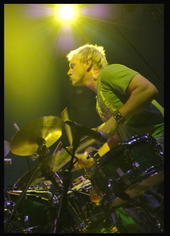 The phone rang kind of early this morning before we were up, and my husband kept saying, "oh man, oh man."
 When he got off the phone, he said the drummer of The Fifteen, a band he plays with occasionally, had passed out Friday night and whoever was there couldn't wake him up. Even though he didn't know the guy real well, he was in a spin all day, trying to find out when the funeral was. Nobody was answering their cell phones. Then he mentioned the guy also played in the Pat McGee Band, so I googled Pat McGee, which sent me to a Wikipedia entry, which had already been updated.
Drummer Chris Williams passed away peacefully in his home October 28th 2006.
Monday, October 23, 2006
So I Was High on the Hog Once
I mentioned to my husband the other day that I had come under fire for never having attended a High on the Hog. "Yes, we did," he said.
We went the one year it was held on Mayo Island, the year Chuck made the brown "Southpork" T-shirts when each character in South Park looked like a pig. According to the shirt, the bill that year (1998) was Page Wilson & Reckless Abandon, Jim Dudley's Chez Roue, the Janet Martin Band, Car Bomb Inc. (one of my favorites), and Bobby Parker and the Blues Night Band.
My husband literally has a hundred T-shirts or more, and this is after we took out three garbage bags full of them several years ago. His whole life story is told in souvenir T-shirts. And someone else's life as well, because his mother always brings him back a shirt from her vacations, so he has shirts from places he's never been. But he only wears about 10 of them, which reminds me of the Seinfeld episode where Jerry riffs on the theory of the favorite T-shirt, which one fateful day doesn't survive the wash and dry, and the second favorite T-shirt takes its place, and on down the line.
We went the one year it was held on Mayo Island, the year Chuck made the brown "Southpork" T-shirts when each character in South Park looked like a pig. According to the shirt, the bill that year (1998) was Page Wilson & Reckless Abandon, Jim Dudley's Chez Roue, the Janet Martin Band, Car Bomb Inc. (one of my favorites), and Bobby Parker and the Blues Night Band.
My husband literally has a hundred T-shirts or more, and this is after we took out three garbage bags full of them several years ago. His whole life story is told in souvenir T-shirts. And someone else's life as well, because his mother always brings him back a shirt from her vacations, so he has shirts from places he's never been. But he only wears about 10 of them, which reminds me of the Seinfeld episode where Jerry riffs on the theory of the favorite T-shirt, which one fateful day doesn't survive the wash and dry, and the second favorite T-shirt takes its place, and on down the line.
Friday, October 20, 2006
This is Not a Socialist Web Site
One thing I've always had to contend with during 11 years of doing a print version of the Richmond Music Journal was the theory that, despite the fact I owned it, produced it, sold the ads, did all the work, etc., some people thought it was supposed to be a people's newspaper and thus be what they wanted it to be, cover local music the way they thought it should be covered, include the bands they wanted to read about in a devoted, supportive way they imagined a local newspaper should be (on what planet, I don't know...papers that did take this approach never made it a year, if you recall).
They have called me every kind of ugly, sexist, woman-bashing name, both privately and publicly, for not meeting their expectations.
The paper was never a significant money-maker for me. My success was that it never went into debt as others did. I printed every submission about local music. Sorry, but I am not going to write everything, and if nobody else writes about it, then it's not going to be written about. I have never had a staff. Never could afford one. In that sense, the paper was socialist and open to everyone. But no one else wanted to do the work.
Those who I consider essential contributors to the paper were the infamous Killer Montone, my partners in the midnight rambling years, Lisa Honeycutt and Anne Soffee, and my last two devoted writers, Robert Stutler and Walter Boelt (who I never met in person). Other writers came and went, but those were the main ones. I had some very devoted advertisers, too, like Moondance, Poe's Pub, A Major Music, Boulevard Deli, and Oasis that kept the paper alive. And if you wrote a couple of things or contributed a few photos over the 11 years, thank you very, very much, but you didn't go to the mountain top with us so it's not like I owe you until the end of time.
The web site is even more mine, and I truly do what I want with it and what I have time to do. I pay for it, why shouldn't I? Do your own Web site.
And I have never, ever said I was an expert on music or even knew anything about it. I am good at publishing a paper that doesn't go into debt. That was my skill. I depended on other people's knowledge and tastes for content. When I wrote, it was about what I thought and where I wanted to go, without any claims that I was an expert. There are some local music events and traditions I have never attended, I admit. There's an in-crowd in the local music scene that I have never been a part of and didn't enjoy hanging out with because their heads were often very far up their butts. I sometimes think they were part of the reason more things didn't happen in Richmond. Some of them were nice, but in the Richmond tradition, they just kept hanging on to the way things once were.
I'm not going to debate this with some of you anymore, especially those who haven't even noticed the paper has been gone for more than two years. Just like you were never required to read the paper, you need not visit here either. Go do your own web site.
They have called me every kind of ugly, sexist, woman-bashing name, both privately and publicly, for not meeting their expectations.
The paper was never a significant money-maker for me. My success was that it never went into debt as others did. I printed every submission about local music. Sorry, but I am not going to write everything, and if nobody else writes about it, then it's not going to be written about. I have never had a staff. Never could afford one. In that sense, the paper was socialist and open to everyone. But no one else wanted to do the work.
Those who I consider essential contributors to the paper were the infamous Killer Montone, my partners in the midnight rambling years, Lisa Honeycutt and Anne Soffee, and my last two devoted writers, Robert Stutler and Walter Boelt (who I never met in person). Other writers came and went, but those were the main ones. I had some very devoted advertisers, too, like Moondance, Poe's Pub, A Major Music, Boulevard Deli, and Oasis that kept the paper alive. And if you wrote a couple of things or contributed a few photos over the 11 years, thank you very, very much, but you didn't go to the mountain top with us so it's not like I owe you until the end of time.
The web site is even more mine, and I truly do what I want with it and what I have time to do. I pay for it, why shouldn't I? Do your own Web site.
And I have never, ever said I was an expert on music or even knew anything about it. I am good at publishing a paper that doesn't go into debt. That was my skill. I depended on other people's knowledge and tastes for content. When I wrote, it was about what I thought and where I wanted to go, without any claims that I was an expert. There are some local music events and traditions I have never attended, I admit. There's an in-crowd in the local music scene that I have never been a part of and didn't enjoy hanging out with because their heads were often very far up their butts. I sometimes think they were part of the reason more things didn't happen in Richmond. Some of them were nice, but in the Richmond tradition, they just kept hanging on to the way things once were.
I'm not going to debate this with some of you anymore, especially those who haven't even noticed the paper has been gone for more than two years. Just like you were never required to read the paper, you need not visit here either. Go do your own web site.
Sunday, September 24, 2006
Joe Camel stole my identity
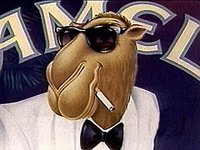
I was in Cary Street Cafe and two guys come in with satchels and little handheld computer-y looking things. The first thing you think is suicide bombers, right? I notice they carefully select people to talk to in the bar, and whoever they select opens their wallet for them. What are they selling? They never talk to me, but I see my husband open his wallet for them. I now notice they are approaching only people who are smoking. Then I figure it out. Then I am appalled.
"Did you just let those guys scan your license?" I asked my trusting, naive husband.
"Yes?" he says, already knowing he did something goofy.
"And you did this for....let me guess, a free pack of cigarettes?!"
"Yes," he says, now even more ashamed. He knows he screwed up. "And they're Camels!" my Marlboro Man adds. He sold out for not even his brand.
I'm desperately thinking what kind of information is on his license. They've got our address, so I guess there will be plenty of mail coming. And if they want, they can reprint the license, replace his photo and now there will be hundreds of illegal aliens claiming to be my husband, living at my address.
I suppose there's some legal reason cigarette companies can't just hand out cigarettes to everyone in a bar like they used to; that they are now required to get and record ID, but it all seems sleazy and invasive. A machine that scans in your license for a pack of cigarettes. It's like Esau selling his birthright for a bowl of porridge. (Old Testament shout-out)
Wednesday, September 13, 2006
No Waffle for You!
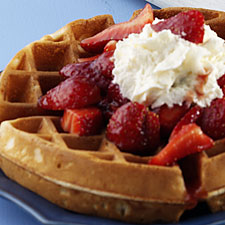
For many musicians, Denny's probably means good memories, somewhere to go eat after a gig, even in Richmond (although here, it was often Toddle House, then Aunt Sara's, then Waffle House). But so far I am 0 for 2 for good memories at Denny's.
The first time was after a troublesome gig at a private party on the Potomac. Someone you all know booked our band, with many promises of money and great, free food and an attentive audience, and none of that materialized. The band had to play in a corner. Most people ignored it. After the music, the food was gone and we still had a long drive back to Richmond, none the richer and very hungry. In desperation, all the band cars pulled into a Denny's where the waitress was too busy to attend to us for a very long time even though the most drunk person in the group bellowed continually, "I need FUD."
Last night we went to Denny's because we had a $5 off coupon. There were only a few people there, including our waitress, Dave Chappelle in a wig and dress. We ordered breakfast, and since I really, really wanted a Belgian waffle with strawberries and nothing else, I predicted I would not get one.
I didn't. After awhile, Waitress returned to say they couldn't get the waffle maker to work. I reluctantly switched to pancakes with strawberries. After awhile, Waitress returned with my husband's food, but she just waved my naked pancakes around without giving them to me. "You wanted strawberries, right?"
Right. I told my husband, "I'm not going to get them." Meanwhile, my pancakes are getting cold because she's walking all over the place with them.
Sure enough, after awhile, she comes back, without the pancakes, and says, "You are gonna be hot!" (Unlike the pancakes.) There's no strawberries. Just give me the pancakes then. I have already written off this meal as not part of my life experience. After another long while, she brings back the pancakes, which by this time have congealed into dry, rubbery flaps of tasteless flour.
So I'm finished with Denny's, although as long as I am married to a musician, I have the bad feeling it is not a definitive "finished."
(Although it is now summer of 2012, and I have not been back to a Denny's. So far, so good.)
Friday, August 11, 2006
A Night at the Market Cafe
We went out to the Market Cafe in Innsbrook on Wednesday to check out the band since my husband was playing there the following night for the first time. There is a vast difference between playing the Cafe on Wednesday and playing it on Thursday. Namely, people. On Wednesdays, you can't find a place to park because there is a show at the Innsbrook Pavilion, and even the Market Cafe is packed. I don't understand that. Why go there instead of the Pavilion?
On Thursday, without a show at the Pavilion, we had just a few tables of people who knew the band. There were few, if any, people who regularly dine or drink at the Market Cafe. You wouldn't go to there for dinner anyway unless you like dried up hot dogs and wilted salad bars. Fortunately, you don't play for the door, but unfortunately, the Market doesn't pay a lot. How can they when they aren't making much money on food or beer. We were there five and a half hours and my husband made $45, so that's $8.18 an hour. I love the music business.
When we pulled up, John said, "Well, so much for the easiest load-in ever," because you could pull up right behind the stage. But there's no gate on the back of the fence. No problem. Everything was hoisted over the fence except the new bass amp which I wheeled down the sidewalk and then pushed through the patio maze of chairs. It was like playing Frogger.
The Market sells you a literal bucket of beer, a tin bucket full of ice and beer. I remember Moondance used to sell buckets of Rolling Rock, but the buckets were smaller. These were big buckets, complete with a can opener. You could get a variety bucket with all sorts of things in it. That's cool, but I don't drink, so no bucket for me.
We were home by 10, which is great. I hate getting home at 3 a.m., especially on a work night. It was a very pleasant night, and being on an outdoor patio is a nice place to hear music. There are no neighbors around to call the police.
On Thursday, without a show at the Pavilion, we had just a few tables of people who knew the band. There were few, if any, people who regularly dine or drink at the Market Cafe. You wouldn't go to there for dinner anyway unless you like dried up hot dogs and wilted salad bars. Fortunately, you don't play for the door, but unfortunately, the Market doesn't pay a lot. How can they when they aren't making much money on food or beer. We were there five and a half hours and my husband made $45, so that's $8.18 an hour. I love the music business.
When we pulled up, John said, "Well, so much for the easiest load-in ever," because you could pull up right behind the stage. But there's no gate on the back of the fence. No problem. Everything was hoisted over the fence except the new bass amp which I wheeled down the sidewalk and then pushed through the patio maze of chairs. It was like playing Frogger.
The Market sells you a literal bucket of beer, a tin bucket full of ice and beer. I remember Moondance used to sell buckets of Rolling Rock, but the buckets were smaller. These were big buckets, complete with a can opener. You could get a variety bucket with all sorts of things in it. That's cool, but I don't drink, so no bucket for me.
We were home by 10, which is great. I hate getting home at 3 a.m., especially on a work night. It was a very pleasant night, and being on an outdoor patio is a nice place to hear music. There are no neighbors around to call the police.
Sunday, May 21, 2006
Burnt Like a Strawberry
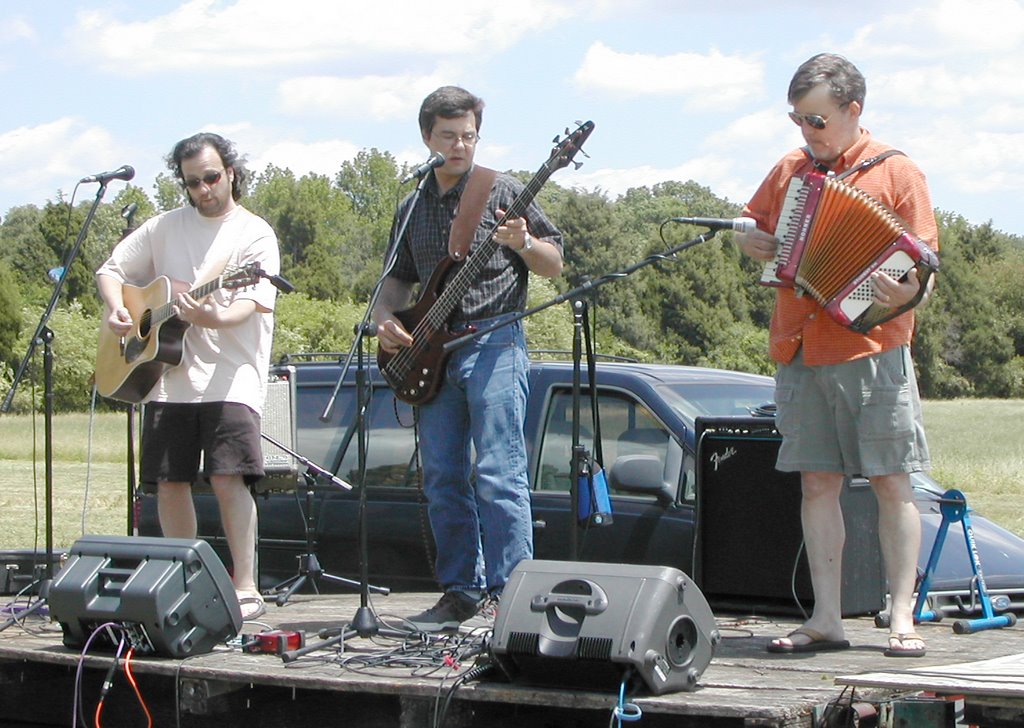
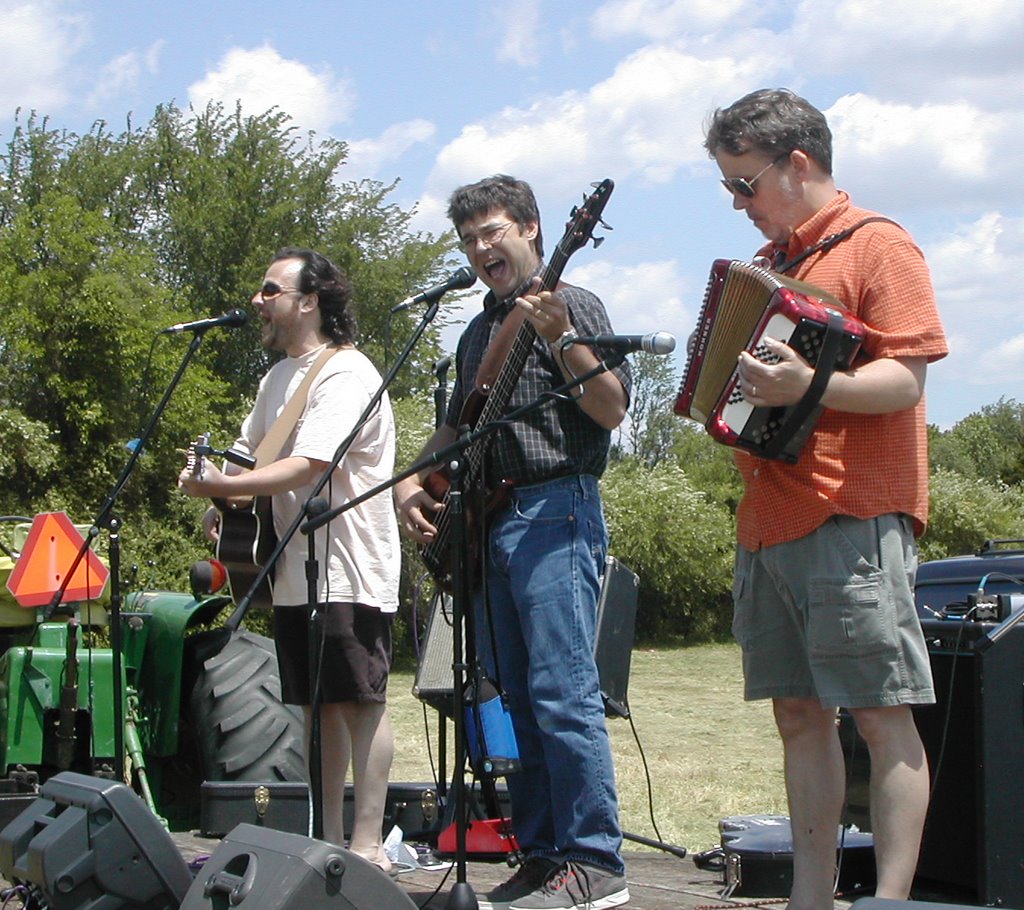 Saturday morning, we drove across town so my husband could stand on the back of a flatbed trailer in the middle of a field under the blazing noon day sun and sing for no money. He's a musician, and more often than not the love of performing is more important than making money at it. Not for the drummer, though. He didn't come. And the frontman was sick. Still, they sounded very good. John and Joe (far left and far right) had already been on the back of the truck for the previous hour playing with the Squalor Hollow Boyz. I kicked myself for not bringing the video camera, because it was a beautiful, although windy, day. And my skin got fried. Should have brought sunblock, too. I'm just not thinking in terms of summer yet.
Meanwhile, the night before, my son was on assignment for Style Weekly, photographing Avail's surprise appearance with Lucero at Nanci Raygun's. The torch passes. Ten years ago, I was photographing bands at that same club (when it was Twisters), but for the Music Journal.
Saturday, May 13, 2006
Elliott Yamin
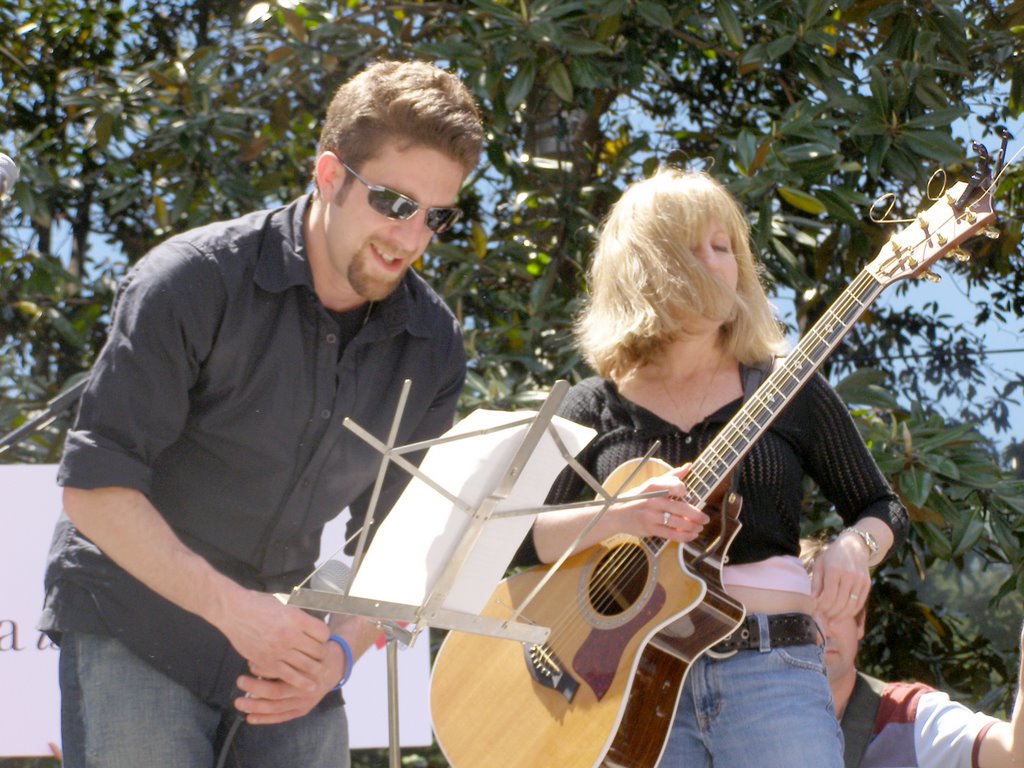
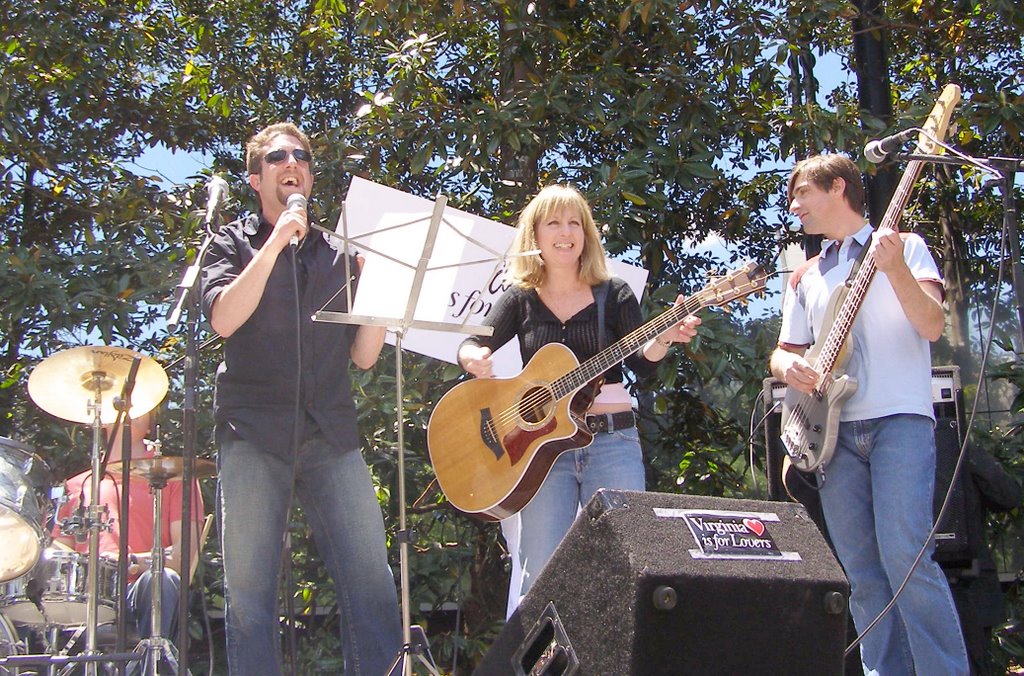
I went to the James Center to see Elliott Yamin. Actually I had to photograph it as part of my day job, but I probably would have gone anyway. I just wouldn't have gotten as close as I did without being credentialed. No surprises. Sometimes you think movie stars are going to be bigger than life, and then you find they're much shorter. Elliott looked exactly like I expected, like he does on TV. Very humble guy. Must be weird to be a nobody on the local Richmond music scene...even a nobody on the total Richmond scene...and then in a span of six months or so, come home to this kind of huge reception.
Susan Greenbaum's band opened for him and ended up playing a half hour more than they planned because Elliott's limo was late.
Subscribe to:
Posts (Atom)